Natural Language Processing Projects Guide
Top 6 NLP Projects
“Can machines truly understand human language?”
This question, once speculative, now defines a significant chunk of innovation in Artificial Intelligence. NLP or Natural Language Processing sits at the intersection of human communication and machine intelligence. Whether it’s a chatbot responding to your queries, a digital assistant managing your schedule, or tools that detect fake news, NLP is enabling machines to grasp the subtleties of human language.
For professionals aiming to transition into data roles, having practical experience in NLP projects reflects your ability to solve modern AI problems. Employers today look beyond theoretical knowledge. They seek professionals who can build and deploy models that add tangible value. For students, NLP projects offer a fast-track way to demonstrate readiness for real-world roles. Develop these projects under the guidance of industry experts at INTTRVU.AI.
In this blog, we’ll walk through the foundations of NLP, explore how it’s evolving, and provide a range of NLP project ideas that are both technically challenging and career-enhancing.
What is NLP (Natural Language Processing)?
Natural Language Processing is a subfield of Artificial Intelligence and Linguistics focused on enabling machines to interpret and manipulate human language. It involves a mix of computational linguistics, statistical modeling, and machine learning to process text or speech data.
Core Components of NLP:
- Tokenization: Breaking text into smaller units such as words or phrases.
- Stop Words Removal: Filtering out common but uninformative words (like “the,” “and,” etc.)
- Stemming and Lemmatization: Reducing words to their root forms.
- Named Entity Recognition (NER): Identifying proper nouns like names, organizations, dates.
- Part-of-Speech Tagging: Assigning grammatical categories to words.
- Dependency Parsing: Understanding the grammatical structure of a sentence.
- Text Classification: Categorizing text into specific labels (spam vs. ham, sentiment polarity, etc.)
NLP is used in applications such as:
- Search engines
- Translation systems
- Sentiment analysis platforms
- Virtual assistants
- Document summarization tools
How NLP is Evolving in 2025
NLP has undergone tremendous transformation with the introduction of deep learning, particularly Transformer-based architectures. As of 2025, key developments include:
Transformer Models
The release of models like BERT, RoBERTa, and GPT has made it possible to understand word context better than ever before. These models use self-attention mechanisms to consider the entire context of a word in a sentence, rather than relying on fixed windows.
Multilingual NLP
Multilingual models such as mBERT and XLM-R are allowing developers to build NLP applications that work across dozens of languages. This is vital for companies operating globally.
Low-Resource Language Processing
Research is focusing on improving NLP in languages that have limited data available. Techniques such as transfer learning and synthetic data generation are making NLP more inclusive.
Explainable NLP
As NLP models become more complex, there is a growing need to make their decisions interpretable. Explainable AI in NLP helps stakeholders understand why a model gave a certain output, enhancing trust and compliance.
Generative AI in NLP
With models like GPT-4 and beyond, generative capabilities are expanding into creating content, code, and even poetry. These models are being integrated into software tools, customer service applications, and content platforms.
Top NLP Projects That’ll Boost Your Resume
Real-world NLP projects not only enhance your technical proficiency but also show employers that you can create end-to-end solutions. Here are several high-impact project ideas with in-depth technical insight, potential scope, applications, and growth opportunities:
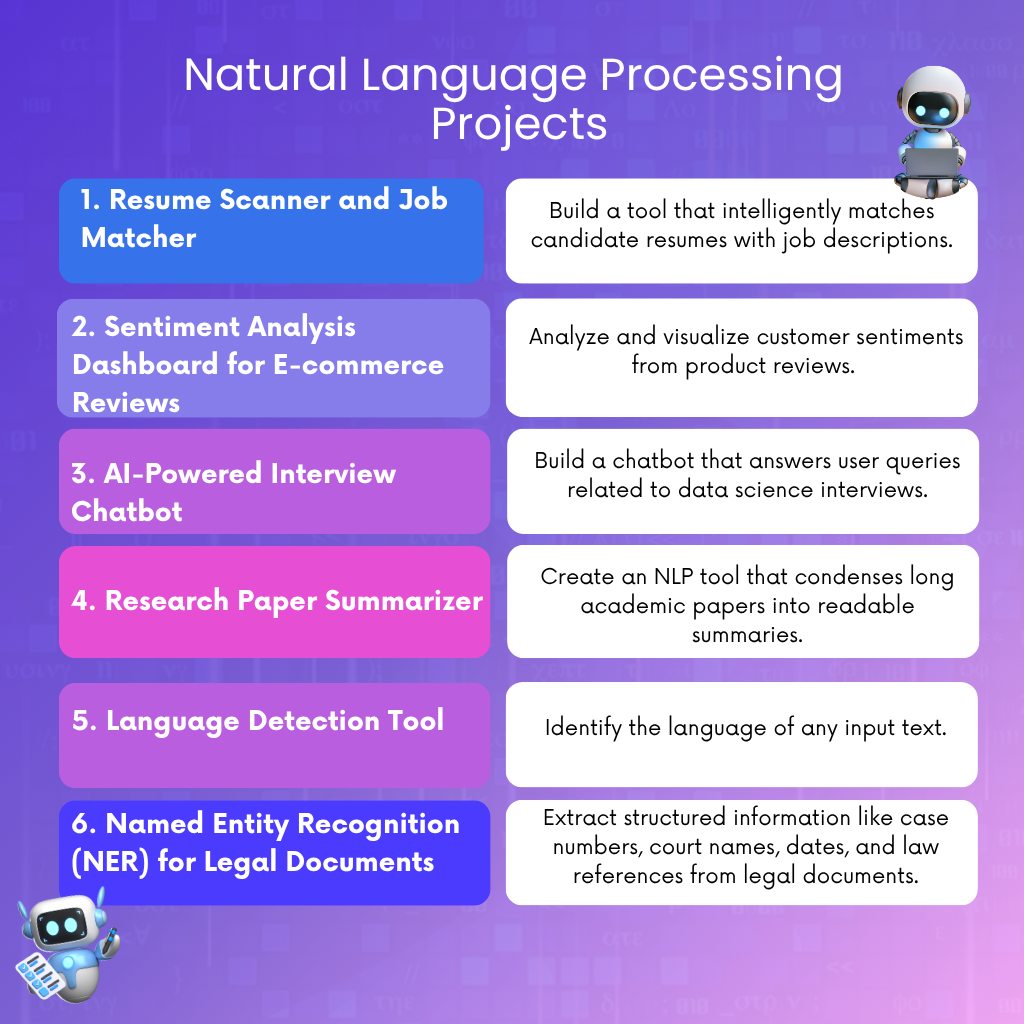
1. Resume Scanner and Job Matcher
Objective: Build a tool that intelligently matches candidate resumes with job descriptions.
Technical Stack:
- Libraries: SpaCy, scikit-learn, Sentence Transformers (for BERT embeddings), Pandas, Flask (for deployment)
- Algorithms: TF-IDF, cosine similarity, semantic search using BERT
Code Insight:
- Preprocess resumes and job descriptions by removing stopwords and lemmatizing.
- Extract keywords and named entities (e.g., skills, roles, degrees).
- Compute similarity scores between job postings and resumes.
Applications: HR tech, job portals, resume filtering tools for recruiters
Scope: Expand it to include feedback on skill gaps and personalized recommendations. Can integrate with LinkedIn APIs for job sourcing.
Future Growth: With the rise in automated hiring platforms, NLP-powered resume matchers can be productized into SaaS tools or internal HR automation systems.
2. Sentiment Analysis Dashboard for E-commerce Reviews
Objective: Analyze and visualize customer sentiments from product reviews.
Technical Stack:
- Libraries: VADER, TextBlob, NLTK, seaborn, Streamlit
- Optional: BERT fine-tuning for multi-class sentiment detection
Code Insight:
- Collect review data from Amazon/Flipkart using APIs or web scraping.
- Preprocess and classify sentiment using VADER or TextBlob.
- Create a Streamlit dashboard with sentiment trends, product-wise graphs, and word clouds.
Applications: E-commerce analytics, customer service, product management
Scope: Expand to include feature extraction (e.g., battery life, delivery) and track sentiment per feature.
Future Growth: Brands are investing heavily in customer experience. Sentiment dashboards are essential for real-time feedback loops.
3. AI-Powered Interview Chatbot
Objective: Build a chatbot that answers user queries related to data science interviews.
Technical Stack:
- Libraries: Rasa, Transformers (GPT, T5), FastAPI, SQLite or MongoDB for context memory
- Data: Real-world QA pairs or scraped content from interview blogs
Code Insight:
- Train a chatbot on QA datasets using intent recognition and context flow.
- Use NLP pipelines to handle ambiguous or follow-up queries.
- Deploy on the web using FastAPI or Flask UI.
Applications: EdTech platforms, mock interview tools, learning assistants
Scope: Expand to cover behavioral interview responses, allow voice input, and give feedback on candidate answers.
Future Growth: Conversational AI is one of the fastest-growing NLP applications. Chatbots that guide learners are becoming standard in learning platforms.
4. Research Paper Summarizer
Objective: Create an NLP tool that condenses long academic papers into readable summaries.
Technical Stack:
- Libraries: PyMuPDF, HuggingFace Transformers (T5, BART), SentencePiece
- Models: Fine-tuned summarization models from HuggingFace
Code Insight:
- Parse PDFs using PyMuPDF and extract the main content.
- Segment content and pass to summarizer in chunks.
- Output bullet-point summaries with clickable references.
Applications: Academia, publishing, legal tech, corporate R&D
Scope: Add summarization types: extractive vs. abstractive. Build citation extractors and support LaTeX inputs.
Future Growth: With the overwhelming volume of research being published, summarizers can help professionals and researchers stay updated efficiently.
5. Language Detection Tool
Objective: Identify the language of any input text.
Technical Stack:
- Libraries: langdetect, langid, FastText, Flask for UI
Code Insight:
- Train a simple classification model or use pre-trained FastText language ID model.
- Detect languages with confidence scores and offer real-time translation options.
Applications: Social media moderation, customer support automation, multilingual apps
Scope: Add translation capabilities and dialect detection.
Future Growth: As businesses go global, the need to support multiple languages through automation will grow significantly.
6. Named Entity Recognition (NER) for Legal Documents
Objective: Extract structured information like case numbers, court names, dates, and law references from legal documents.
Technical Stack:
- Libraries: SpaCy, Regex, Pandas, PyMuPDF, Prodigy (for annotation)
- Models: Fine-tuned SpaCy NER or transformer-based token classifiers
Code Insight:
- Preprocess legal text and create labeled datasets for domain-specific entities.
- Fine-tune SpaCy or BERT for custom entity recognition.
- Visualize extracted entities in structured outputs for legal teams.
Applications: Legal analytics, contract review, law firm automation
Scope: Add summarization, risk assessment, and clause similarity matching.
Future Growth: The legal domain is undergoing rapid digitization. NER tools tailored for legal documents will become essential for compliance and review automation.
Summary Table: NLP Projects Overview
|
Project |
Tools & Techniques |
Career Fit |
Highlights |
|---|---|---|---|
|
Resume Matcher |
SpaCy, TF-IDF, BERT |
ML Engineer, HRTech |
Automates recruitment process |
|
Sentiment Analysis |
VADER, Streamlit, BERT |
Analyst, Data Scientist |
Combines NLP with dashboarding |
|
Interview Chatbot |
Rasa, HuggingFace, Flask |
Conversational AI, Product Dev |
Intelligent user interaction |
|
Paper Summarizer |
T5, PyMuPDF |
EdTech, NLP Research |
Condenses long-form text |
|
Language Detector |
FastText, Flask |
Analyst, Platform Developer |
Fast and multilingual ready |
|
NER for Legal Docs |
SpaCy, Regex |
LegalTech, Data Analyst |
Domain-specific insights |
Conclusion
NLP is a fast-growing field with immense potential. Working on practical NLP projects not only strengthens your resume but also demonstrates hands-on capability in solving real-world language problems. Whether you’re trying to switch roles or upscale in your current job, showcasing well-documented NLP projects can give you a strong edge.
These projects can be hosted on GitHub, accompanied by blog write-ups or demo videos. Additionally, they’re often discussed in interviews for data science and AI roles, especially when you’re aiming for companies working with search engines, chatbots, customer analytics, or text-driven workflows.
At INTTRVU.AI, we understand what hiring managers look for. Our hands-on Data Science and AI programs are designed to help you build impactful projects, prepare for interviews, and transition into roles like Data Scientist, Data Analyst, AI Engineer, AI/ML Specialist
If you’re ready to transform your career with real-world projects, structured mentorship, and personalized mock interviews, explore our offerings today.
Visit https://inttrvu.ai/data-science-ai/ to get started.
Frequently Asked Questions:
Q1. Are these NLP projects suitable for beginners?
Yes, most of the projects start with simple implementations using Python libraries. You can gradually scale them with more advanced models like BERT or GPT.
Q2. Do I need deep learning for all NLP projects?
No. While deep learning helps, many NLP tasks can be handled effectively with traditional ML and rule-based approaches initially. Deep learning becomes essential when scaling or improving performance.
Q3. How can I showcase these projects to recruiters?
Host your code on GitHub, write a blog post explaining the project, and link it on your LinkedIn. If possible, deploy your project using Streamlit, Flask, or Gradio.
Q4. Which project has the highest impact in job interviews?
Projects like Chatbots, Sentiment Analysis, and Fake News Detection demonstrate business relevance and are often discussed during technical rounds.
Q5. Where can I find good datasets for NLP?
You can find quality datasets on Kaggle, Hugging Face Datasets, UCI Machine Learning Repository, and Google Dataset Search.

Building Data Science Team Strategy
Master the 7-step formula to create a data science team that influences decisions, drives revenue, and delivers measurable business impact.
Read More »

Master Data Science While Working | Best Data Science Course
Master data science without quitting your job. Discover practical strategies, real-world projects, and expert tips to balance work and learning. Explore the best data science classes and find the right data science course to grow your career in data science.
Read More »
Enter the Data Science Field with No Prior Experience
Thinking about a career switch? This blog explains how to transition into data science step by step. Explore a beginner-friendly data science course and a practical data science course syllabus that covers Python, SQL, machine learning, and portfolio-building to help you land your first role.
Read More »